 coco
6.9 KiB
title, source, author, published, created, description, tags
| title | source | author | published | created | description | tags | ||
|---|---|---|---|---|---|---|---|---|
| How Transformers Work: A Detailed Exploration of Transformer Architecture | https://www.datacamp.com/tutorial/how-transformers-work |
|
2024-01-09 | 2026-03-08 | Explore the architecture of Transformers, the models that have revolutionized data handling through self-attention mechanisms, surpassing traditional RNNs, and paving the way for advanced models like BERT and GPT. |
|
Understand Transformer architecture, including self-attention, encoder–decoder design, and multi-head attention, and how it powers models like OpenAI's GPT models.
TL;DR
- Transformers are neural network architectures that use self-attention mechanisms to process sequential data in parallel, replacing the need for recurrence
- Key components: input embeddings, positional encoding, multi-head self-attention, feed-forward networks, and layer normalization with residual connections
- Encoder-decoder structure: encoders create contextualized representations; decoders generate output sequences autoregressively
- Modern variants: GPT-5, Claude, Llama, and Gemini for language; Vision Transformers (ViT) for images; multimodal models for combined inputs
- Efficiency innovations: Flash Attention, Rotary Position Embeddings (RoPE), and linear attention variants address the quadratic complexity bottleneck
The deep learning field has been experiencing a seismic shift, thanks to the emergence and rapid evolution of Transformer models.
These groundbreaking architectures have not just redefined the standards in Natural Language Processing (NLP) but have broadened their horizons to revolutionize numerous facets of artificial intelligence.
Characterized by their unique attention mechanisms and parallel processing abilities, Transformer models stand as a testament to the innovative leaps in understanding and generating human language with an accuracy and efficiency previously unattainable.
First appeared in 2017 in the “Attention is all you need” article by Google, the transformer architecture is at the heart of groundbreaking models like ChatGPT, sparking a new wave of excitement in the AI community. They've been instrumental in OpenAI's cutting-edge language models and played a key role in DeepMind's AlphaStar.
In this transformative era of AI, the significance of Transformer models for aspiring data scientists and NLP practitioners cannot be overstated.
As one of the core fields for most of the latest technological leap forwards, this article aims to decipher the secrets behind these models.
AI Upskilling for Beginners
Learn the fundamentals of AI and ChatGPT from scratch.
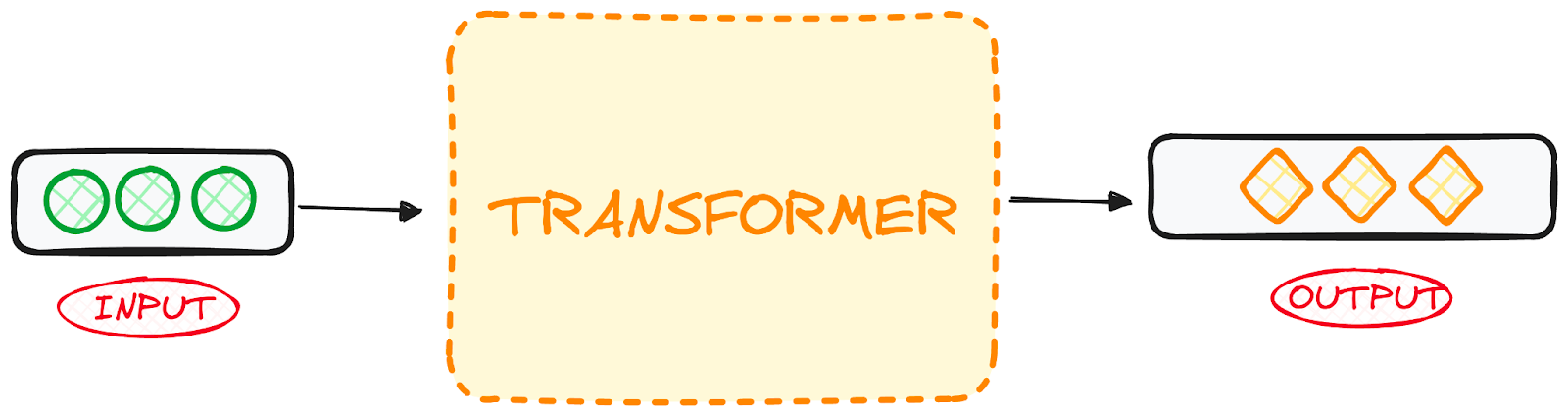
The transformer architecture as a black box.
Earn a Top AI Certification
Demonstrate you can effectively and responsibly use AI.

Author
Josep Ferrer
Josep is a freelance Data Scientist specializing in European projects, with expertise in data storage, processing, advanced analytics, and impactful data storytelling.
As an educator, he teaches Big Data in the Master’s program at the University of Navarra and shares insights through articles on platforms like Medium, KDNuggets, and DataCamp. Josep also writes about Data and Tech in his newsletter Databites (databites.tech).
He holds a BS in Engineering Physics from the Polytechnic University of Catalonia and an MS in Intelligent Interactive Systems from Pompeu Fabra University.
Topics
Learn More About Transformers and LLMs!
Course
Large Language Models (LLMs) Concepts
2 hr
86.2K
Discover the full potential of LLMs with our conceptual course covering LLM applications, training methodologies, ethical considerations, and latest research.
Course
Introduction to LLMs in Python
3 hr
30.3K
Learn the nuts and bolts of LLMs and the revolutionary transformer architecture they are based on!
Course
Large Language Models for Business
1 hr
14.3K
Learn about Large Language Models (LLMs) and how they are reshaping the business world.
[
See More
](https://www.datacamp.com/courses-all)
Related
 Google's Titans Architecture: Key Concepts Explained
blog
Learn how Google's Titans architecture enhances the Transformer's attention mechanism by incorporating a memory system inspired by the human brain.
François Aubry
8 min
 Flash Attention Explained: A Comprehensive Guide
blog
Learn what Flash Attention is, how it works in transformer models, and why it optimizes LLM performance. Discover tiling and recomputation in FA1, FA2, and FA3.
Srujana Maddula
12 min
 What are Foundation Models?
blog
Discover the key technology that is powering the generative AI boom
Javier Canales Luna
9 min
 Transformer Model Tutorial in PyTorch: From Theory to Code
Tutorial
Learn how to build a Transformer model using PyTorch, a powerful tool in modern machine learning.
Arjun Sarkar
Understanding Multi-Head Attention in Transformers
Tutorial
Learn what multi-head attention is, how self-attention works inside transformers, and why these mechanisms are essential for powering LLMs like GPT-5 and VLMs like CLIP, all with simple examples, diagrams, and code.
Vaibhav Mehra
Vision Transformers (ViT) Tutorial: Architecture and Code Examples
Tutorial
Learn how Vision Transformers (ViTs) leverage patch embeddings and self-attention to beat CNNs in modern image classification. This in-depth tutorial breaks down the ViT architecture, provides step-by-step Python code, and shows you when to choose ViTs for real-world computer-vision projects.
Vaibhav Mehra